 |
|
|
| Postée par admin le mardi 01 mars 2011 à 23:11 |

Lamborghini Aventador LP 700-4
Avec la toute nouvelle Aventador LP 700-4, Automobili Lamborghini redéfinit
le summum du marché mondial des supersportives – puissance brute, poids
plume et précision directionnelle phénoménale, combinés à un design hors
pair et des équipements ultra sophistiqués afin d'offrir une expérience et un
plaisir de conduite inégalés. Avec l'Aventador, Lamborghini franchit un
nouveau pas et perpétue la légende de la marque au taureau. La livraison des
premières Lamborghini Aventador LP 700-4 est prévue vers la fin de l’été
2011.
La Lamborghini Aventador LP 700-4 se distingue par une technologie
résolument unique, reposant sur une monocoque en fibre de carbone ultra
légère mais néanmoins rigide et parfaitement sécurisante. Le nouveau moteur
V12 d'une cylindrée de 6,5 litres et développant 515 kW/700 CV combine
l'euphorie des montées dans les tours à un couple impressionnant disponible
dès les bas régimes. Grâce à un poids à sec d'à peine 1.575 kg, ce qui est
extrêmement peu pour une voiture de cette catégorie, le rapport
poids/puissance n'est que de 2,25 kg par CV. Malgré une accélération
fulgurante de 0 à 100 km/h en 2,9 secondes, une vitesse de pointe culminant à
350 km/h et un impressionnant gain de puissance de 8% par rapport à son
prédécesseur, la consommation et les émissions de CO2 de l'Aventador ont été
réduites de 20%.
La dernière-née de Lamborghini est équipée d'une boîte ISR aux rapports ultra
courts, ce qui garantit un passage des rapports à une vitesse de l'ordre de 50
millisecondes et entretient la passion de la conduite, tandis que le châssis
léger monté sur des suspensions à poussoirs assure une maniabilité et une
3
précision absolues, ainsi que des performances dignes des bolides de
compétition. Même impression de luxe et d'identité marquée à l'intérieur,
grâce aux équipements high-tech du cockpit, comme l'écran TFT avec système
de sélection du mode de conduite (Drive Select Mode). L'Aventador est conçue
pour répondre aux normes les plus strictes et les plus exigeantes et sera
produite sur une toute nouvelle chaîne de production à Sant’Agata Bolognese.
"Avec l'Aventador LP 700-4, l'avenir des supersportives se décline désormais
au présent. Son arsenal de technologies novatrices est unique. Ses
performances sont tout simplement époustouflantes”, déclare Stephan
Winkelmann, président-directeur général de Automobili Lamborghini. "Avec
l'Aventador, nous réalisons un bond conceptuel et technologique de deux
générations. Fruit d'un projet d'avenir, elle perpétue néanmoins les valeurs
traditionnelles de la célèbre marque au taureau. Extrême au niveau du design
et des performances, intransigeante en matière de technologie et
incontestablement italienne pour ce qui est de l'élégance et de l'excellence,
l'Aventador LP 700-4 est sans rivale sur le marché des voitures
supersportives."
L'Aventador doit son nom à un des taureaux les plus braves de l'histoire
Fidèle à sa tradition, Lamborghini a baptisé le dernier fleuron de la marque du
nom d'un taureau héroïque qui a marqué l'histoire de la corrida espagnole.
Aventador est le nom d'un taureau qui pénétra dans l'arène de Saragosse en
octobre 1993 où il remporta le "Trofeo de la Peña La Madroñera" pour sa
bravoure exceptionnelle. |
Commentaires (0)    |

| Postée par admin le samedi 26 février 2011 à 17:42 |
1er VRAIES photos de la LP 700-4
rajout de 5 nouvelle photos de la Lp700-4 prise lors du montage du stand Lamborghini au Geneva Motor show
  d'autres photos , un clic sur l'image: d'autres photos , un clic sur l'image:
thanks :
www.autogespot.com |
| Commentaires (0) |
| Postée par kldconcept le mardi 22 février 2011 à 16:35 |
Lamborghini unveils V12 rolling chassis in advance of car's Geneva launch
Sant'Agata Bolognese, 22nd February 2011 - At a TechDay event in
collaboration with Audi, Automobili Lamborghini unveils the rolling
chassis of its new V12 to be launched at Geneva motor show on 1st
March.
1. Lightweight engineering with carbon-fiber technology
Lamborghini is redefining the future of the super sports car with
expertise unparalleled worldwide
 d'autres photos , un clic sur l'image: d'autres photos , un clic sur l'image:
* Systematic lightweight design concept for extreme dynamics and
outstanding efficiency
* Full monocoque for the new V12 model with exceptional characteristics
* Worldwide leading know-how in development, production and
application of carbon-fiber materials
* New production system uses innovative technologies to the highest
quality standards
* Investments in carbon fiber demonstrate the innovative strengths and
forward-looking power of the brand
Lamborghini is heading into the future with a systematic lightweight design concept - the intensive application of carbon-fiber materials forms the key foundation for the extreme dynamics and less emissions that will define its future super sports cars. The new V12 model that will debut at the 2011 Geneva motorshow is based on a full monocoque construction made from innovative carbon-fiber technology and superior to anything else on the market - developed and produced entirely by Automobili Lamborghini.
This development sees Lamborghini once again demonstrate its worldwide leading expertise in carbon-fiber reinforced plastics (CFRP) technology. The super sports car brand from Sant?Agata Bolognese is the only automaker to have fully mastered the extensive CFRP process across a range of technologies in-house - through design, simulation, engineering, prototyping, testing, validation and production, using state-of-the-art industrial processes to the very highest quality standards. Lamborghini is putting its innovative, inhouse developed and patented technologies into series production for the first time with the successor to the Murciélago.
 d'autres photos , un clic sur l'image: d'autres photos , un clic sur l'image:
"Systematic lightweight engineering and an optimum power-to-weight ratio are absolutely crucial to the super sports cars of the future, for both the highest levels of driving pleasure and lower emissions," says Stephan Winkelmann, President and CEO of Automobili Lamborghini. "Lamborghini has put a lot of hard work into growing its expertise in the application of CFRP, attaining the leadership position we hold today. With its innovative carbon3 fiber monocoque, the successor to the Murciélago displays the full competence of our brand and starts a new chapter in the history of Lamborghini." |
| Commentaires (0) |
| Postée par admin le samedi 12 février 2011 à 08:23 |
Lamborghini makes no compromises in the engineering and construction of its new flagship's all-carbon fiber monocoque
- Monocoque forms a single shell in carbon fiber
- Built entirely in-house by Lamborghini with patented process
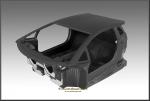
Lamborghini's Geneva motor show launch of its Murciélago replacement promises an extraordinary new technology-driven super sports car. One significant feature will be the extensive use of carbon fiber-reinforced polymer (CFRP) technology throughout the car, and in particular, in the entirely carbon fiber composite monocoque.
The cell of the future Lamborghini flagship super sports car is made entirely from carbon fiber and has been designed as a monocoque structure. The load-bearing structure of the vehicle is engineered as a “single shell” that functions physically as one component, thus taking full advantage of the extreme rigidity of CFRP. Formula 1 race cars have been built using CFRP monocoques for many years – and have proven their crash worthiness time and again. The same applies to road-going sports cars featuring monocoque technology – the carbon fiber occupant cell functions like an extremely safe roll cage.
 d'autres photos , un clic sur l'image: d'autres photos , un clic sur l'image:
Construction offer many advantages
Of course, the term “single shell” applies only in the descriptive sense – the new Lamborghini monocoque is made from a series of individual parts with specific functions, such as stiffening elements made from Braiding technology, that is one of the best technology to manage energy adsorption in case of crash. After the curing process, however, this structure functions as a single component – including the base section known as the tub and the complete roof.
The full monocoque solution offers advantages which other processes, like a tub where a metal roof structure is attached in a conventional manner, cannot realize. That's why Lamborghini made the no compromise choice of the full monocoque, which weighs only 147.5 kilograms (324.5 lbs).
Extremely rigid construction
Superior passive safety is only one benefit of the extreme rigidity of a full carbon fiber monocoque - very high torsional rigidity is another. The monocoque is connected at the front and rear with equally rigid aluminum sub-frames, on which the suspension, engine and transmission are mounted.
The entire body-in-white of the future V12 model weighs only 229.5 kilograms (505 lbs) and boasts phenomenal torsional rigidity of 35,000 Newton meters per degree of twist. This guarantees a superb feeling of solidity, but, more importantly, extremely exact wheel control with excellent steering precision and sensitive feedback. For the dedicated driver, both are essential for truly enticing driving pleasure. The new Lamborghini flagship responds to the most minute steering input with the stunning precision of a perfectly balanced race car.
Depending on the form, function and requirements of the individual elements, the Lamborghini development team selected from three main CFRP manufacturing methods within its technology tool kit. They differ not only in their production processes, but also in the type of carbon fiber and its weave and, most importantly, in the chemical composition of the synthetic resin used.
Resin Transfer Moulding (RTM): In this process the carbon fiber mats are preformed and impregnated with an exact amount of resin. Afterwards, they are cured under heat while the part is in the mold. Lamborghini has achieved a major breakthrough by further developmening this method. Using the patented “RTM-Lambo” process, the final mold is no longer a heavy, complex metal piece, but is made instead from lightweight carbon-fiber parts, thus making the manufacturing process faster, more flexible and more efficient.
An additional benefit of the RTM-Lambo process is the low injection pressure that doesn't require expensive equipment.
_tmb.jpg) d'autres photos , un clic sur l'image: d'autres photos , un clic sur l'image:
Prepreg – The carbon fiber mats used in this method, commonly known as prepreg, are pre-injected by the supplier with a thermosetting liquid resin and must be stored at a low temperature. The mats are then laminated in molds and cured under heat and pressure in an autoclave. Prepreg components are complex to make, but have an extremely high-quality surface finish (Class-A surface quality) and are therefore the preferred option for use in visible locations.
Braiding – These components are manufactured by using RTM technology. This carbon fiber weave technology is derived from the textile industry and used to make tubular components for special applications such as structural roof pillars and rocker panels. The woven components are made by diagonally interweaving the fiber in several layers.
The monocoque of the new V12 super sports car is constructed using these technologies applied in a series of special processes. One significant advancement Lamborghini realized is the ability to use already-assembled monocoque elements as the mold for the next step in the process. This makes for a considerable simplification of the manufacturing process compared with conventional methods.
Epoxy foam components are also used within the monocoque. They are placed in strategic points to increase the stiffness of the monocoque by working as spacers between the composite layers while also dampening noise and vibration. In addition, aluminum inserts are laminated into the front and rear surfaces to facilitate connection with the aluminum front and rear sub-frame elements.
Because of the complexity of the materials and process outlined above, Lamborghini decided to produce its new monocoque completely in-house, managing one strategic step in the production process.
Quality control is an absolutely crucial factor – every single monocoque is measured to exacting tolerances of only 0.1 millimeters, facilitating the extreme precision of the overall vehicle. Quality control starts with the purchase of the carbon fiber parts. Every delivery of carbon fiber is certified and the material is checked regularly for compliance with quality standards. Lamborghini worked together with its suppliers to develop a world-exclusive fiber and resin system for its RTM technology. Ultimately, these materials and processes constitute an important part of Lamborghini's worldwide leading expertise in the field.
Carbon composite materials - A key technology for tomorrow's high-performance automotive engineering
These materials made from CFRP combine the lowest possible weight with excellent material characteristics – they are very light, extremely rigid and exceptionally precise.
Furthermore, CFRP materials can also be formed into highly complex components with integrated functions. This reduces the number of individual parts when compared to traditional metal construction – thus enabling further weight reduction. Lighter cars have lower fuel consumption and fewer CO2 emissions. Most significantly, however, it improves the power-to-weight ratio – the deciding factor in the overall feel and performance of a sports car. A super sports car built using CFRP accelerates faster, has superior handling and better braking.
|
| Commentaires (0) |
| Postée par kldconcept le mercredi 26 janvier 2011 à 21:55 |
Lamborghini presents the Gallardo LP 560-4 Bicolore – An extreme look for a Special Edition supersports car
Just a month before the world debut at Geneva Motor Show of its V12 replacement for the Murciélago, Automobili Lamborghini is presenting at the 2011 Qatar Motor Show a highly exclusive and appealing vehicle making its world premiere: the Gallardo LP 560-4 Bicolore, a Special Edition supersports car which will be produced for the European and Asian-Pacific markets, while for the American market it will be only available in the version LP 550-2. As its name implies, this special series features an exclusive two-tone finish with matching interior, and offers a full range of standard equipment. A refined contrast between the black roof and the color of the rest of the body (available in a choice of five shades) further emphasizes the sharp, dynamic lines of the Gallardo LP 560-4, while simultaneously enhancing its sportiness and adding a touch of elegance to an extremely presti gious model in the field of automotive design.
 More photos, click on the image: More photos, click on the image:
The most successful super sports car in Lamborghini's history captures the imagination with the brutal power of its 560 hp V10 engine, the absolute grip of its permanent all-wheel drive and the razor-sharp precision of its chassis. Every kilometer in the Lamborghini Gallardo is an intense experience of explosive dynamics and absolute control. Its breathtaking performance is indicated by the 3.7 seconds it takes to reach 100 km/h and its top speed of 325 km/h.
"With the Gallardo LP 560-4 Bicolore, Lamborghini demonstrates once again the extreme, uncompromising and unmistakably Italian nature of our brand. The super sports cars from Lamborghini combine volcanic energy with design that is as unique as it is stylish," says Stephan Winkelmann, President and CEO of Automobili Lamborghini.
Unique design DNA
The success of Lamborghini's unequalled design DNA lies in the beauty of highly-concentrated power and precise function. The Gallardo is the sheer essence of form with a purist approach, so the body shell is crisply sculpted and completely free from decoration. A timeless piece of design and an uncompromising driving machine – the Lamborghini Gallardo is both.
Even more extreme, thanks to a personalized appearance
With its new Bicolore model, Lamborghini is now setting a further design highlight in the ten-cylinder model series. The colored exterior finish matched with the black on the upper area of the body gives the Gallardo a new, more aggressive personality that looks even wider, even more extreme and innately adhered to the road.
From the window-line upwards (including pillars, roof, engine hood and rear spoiler), the vehicle is decorated in Noctis Black - a pastel black that contrasts perfectly with the lower area of the body, available in a choice of five colors: Giallo Midas, Arancio Borealis, Grigio Telesto, Bianco Monocerus and Blu Caelum.
The exterior appearance is enhanced by Skorpius aluminum-alloy rims with 15 thin spokes that are forged to minimize unsprung weight and are finished in titanium gray enamel. And, the air intakes and front spoiler have a high-gloss black finish, as does the upper section of the rear diffuser.
 d'autres photos , un clic sur l'image: d'autres photos , un clic sur l'image:
Top-quality and highly individual interior
The contrast between black and color is repeated in an understated, elegant manner in the interior of the Gallardo LP 560-4 Bicolore. The instrument panel, seats, door panels and other elements in the passenger compartment are upholstered in the finest "Nero Persus" leather, with a refined contrast provided by precise stitching that is colored to match the exterior paintwork: yellow, orange, blue and gray (also used on the Bianco Monocerus version).
The bezel of the e-gear transmission on the center console is in Nero Noctis, just like the upper area of the vehicle. Obviously, the interior is finished in the Lamborghini tradition using only the materials of the very highest quality, which are crafted with undisputed professionalism and fine Italian workmanship.
V10 like a work of art in a glass display
The complete range of standard equipment includes the fast e-gear automated transmission controlled by paddles on the steering column. A lifting system enables the front axle to be raised for safer travel onto ramps and over humps in the road, and the engine hood in tempered glass provides a stunning view of the heart of the vehicle: a 5.2 liter, 90° V-10 engine with stratified direct injection.
From a satellite navigation system to a rear-view camera, from a brake system with carbon-ceramic discs to heated power seats, a long list of optional equipment and accessories allows the vehicle to be adapted to the personal requirements of any client.
Unique success for a super sports car
Well over 10,000 Gallardos have left the production facility at company headquarters in Sant'Agata Bolognese – a unique success story in the world of super sports cars. The Bicolore Special Edition is particularly intended for the enthusiast who desires a supercar with an exclusive appearance and remarkable design. In any event, he or she will own a Lamborghini that is altogether distinguished by an extremely dynamic character, maximum driving excitement, yet an ability to be driven daily.
 d'autres photos , un clic sur l'image: d'autres photos , un clic sur l'image:
Individual characters in one model range
The Gallardo Bicolore completes Lamborghini's ten-cylinder model range, which is enjoying enormous resonance worldwide with its broad spectrum of individual characters. While the Gallardo LP 560-4 is already a highly trained, extreme athlete, the Gallardo LP 570-4 Superleggera takes the notion of thoroughbred high performance even further. Thanks to its extensive experience in carbon-fiber lightweight engineering, Lamborghini succeeded in reducing its weight by a further 70 kilograms. At 2.35 kilograms per hp, the power-to-weight ratio of the Superleggera is the best in its class, with breathtaking performance guaranteed.
The Gallardo LP 560-4 Spyder, on the other hand, offers a very different kind of extreme driving pleasure – every trip with the roof down is a journey with a hurricane, yet with maximum protection. This can only be bettered – in true Lamborghini style – by the Gallardo LP 570-4 Spyder Performante. Its purist carbon-fiber lightweight engineering, according to Lamborghini's tradition, adds an even sharper edge to the dynamics.
|
| Commentaires (0) |
Page : < 1 2 3 ... 5 [6] 7 ... 30 31 32 >
|
|
| |



 - Video Youtube
 - Instagram
 - Facebook
 - Tweetez @kldconcept
